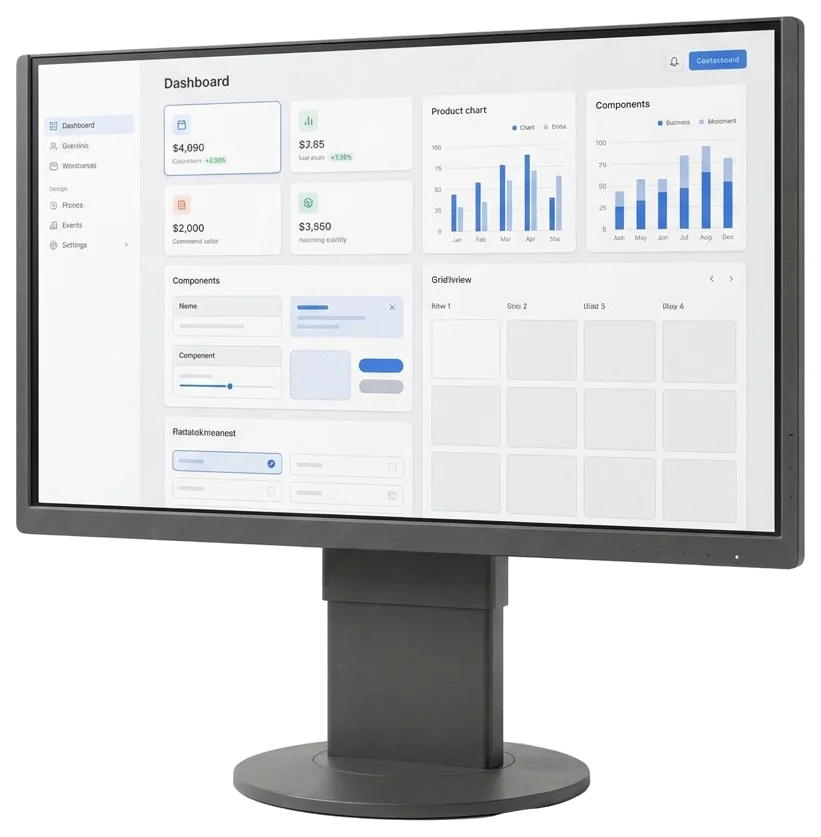

B2B SaaS UX/UI covers every interface of software sold to businesses on a subscription: onboarding, dashboards, data screens, settings, role management, billing and back office. The goal is twofold: win the trial and become indispensable in daily use.
What I learned building a SaaS
I cofounded WeeFizz and led its product, a size recommendation SaaS for fashion brands: a widget integrated into four e-commerce CMS platforms, a client dashboard, an internal back office, a super admin area, onboarding, subscriptions and client migration. I also designed and built Reformer Society, a multi-tenant platform for studios, with white label, Stripe subscriptions and three separate areas.
That experience changes how I design: I know what a screen costs to build, what a customer asks support, and what one feature too many does to retention.
The screens that matter in a SaaS
| Screen | Stake | What I do |
|---|---|---|
| Onboarding | First value as fast as possible | Fewer steps, realistic demo data, visible progress |
| Dashboard | Decide at a glance | Metric hierarchy, comparison over time, zero decorative charts |
| Data tables | Work fast across many rows | Adjustable density, sorting, filters, bulk actions, useful empty states |
| Settings | Configure without getting lost | Grouping by intent, safe defaults, preview |
| Roles and permissions | Security without friction | Simple model, conditional display, explicit messages |
| Pricing and subscription | Convert and retain | Readable plans, clear trial, plan changes and cancellation without tricks |
| Internal back office | Help the support team work fast | Global search, complete customer records, traceable actions |
Ten principles for B2B SaaS
I detail them with examples in B2B SaaS UX: 10 principles. In short:
- First value before first configuration.
- One primary action per screen.
- Real data from day one, never an empty screen.
- Density is adjustable, not imposed.
- Every error state says what to do.
- Roles are visible, not guessed.
- Perceived speed is a feature.
- The design system is the contract with developers.
- Pricing makes sense without calling sales.
- Measure before and after every change.
Multi-tenant and white label
Many SaaS companies resell their product to clients who want their own identity. I have designed systems where the accent color, logo and imagery are overridden per client without duplicating components: one design system, one theme attribute, semantic tokens. It is also a design system and performance concern.
Analytics and trust
A SaaS lives on trust in its numbers. At WeeFizz, the analytics redesign brought readable bar charts, a per-product view and an explicit confidence indicator on every recommendation. A number you do not understand is a number you do not believe.
Engagement formats
- SaaS UX/UI audit: two weeks, quantified priorities, action plan. See audit.
- Flow redesign sprint: onboarding, pricing, dashboard. Three to six weeks.
- Embedded product designer: three to twelve months, with the product and engineering team.